From the category “Things that Austria should be ashamed for”: Its reaction to “Turkish” milk

Posted in "kultur", marken by thomas on the August 26th, 2010

Foto: APA/Herbert Pfarrhofer

1803 comments to date at the website of Austria’s liberal daily “Der Standard”. Countless protest mails and calls at their headquarter and supposedly a call to boycott the brand in some parts of the internet that I’m not familiar with. And all because of what? Because NÖM - the milk brand from Lower Austria - decided to exclusively supply 300 Turkish supermarkets with bilingual milk packages. Every product in Austria has a multi- or at least bilingual packaging, but mention “Turkish” once in affirmative way in Austria and you provoke a public outcry.

“The Evolving Role of Creativity in Brand Management” aka my Bachelor Paper and Planning Barcamp topic

Posted in bachelor thesis / Bakk-Arbeit, marken, uni by thomas on the August 25th, 2010

This weekend, I am going to fly up to Hamburg to meet with a bunch of interesting people at the Planning Barcamp, a mini/un-conference around the overarching theme of “Context”. As Michaela asked us to come up with topics, I thought it might be a good idea to suggest the title of my bachelor paper that otherwise nobody else would probably read anyways. So, as a preview of what I am going to talk about on Friday (in a less academic and hopefully more interesting way), here’s the preliminary introduction to my “thesis”:

(Thanks to Christian Riedel, and Michaela for organizing and to the APGD and the Good School for supporting it.)

Creativity is an often used word in the context of marketing communications and brand management. There are magazines named after it, such as Creativity and Creativity Review, there are numerous awards around the globe judging and celebrating it and there is the APG Creative Planning award, which rewards creative strategy in the context of marketing communications and planning.

Creativity, of course is also the selling point of almost every agency or agency-like company trying to make a living in the widening domain of marketing services.

We put the creative function at the top of our priorities.

Creativity Is The Most Powerful Force In Business. […] DDB’s pursues collaborative relationships with clients and partners to find the hidden potential of people, brands and business through creativity.

[Wieden + Kennedy is] an independent, creatively-led communications agency.

We connect ideas and innovation to deliver award-winning results for the world’s leading brands.

We are creative problem-solvers.

We are a creative company with 186 offices and 7000 colleagues united around a single mission: To Resist the Unusual.

Our industry is undergoing radical transformation. To keep pace with the changes being driven by emerging technology, it is vital to focus on collaboration, creativity and organizational flexibility,

MDC Partners fosters the entrepreneurial spirit of our Partner firms by encouraging creativity and autonomy while providing human and financial resources to accelerate growth.

Both independent agencies as well as large established agency networks claim to be at the forefront of creativity. More precisely, as Zurstiege (cf. 2005: 179ff) puts it, what agencies aim to offer and what marketers ask for is effective creativity or creative effectiveness. Therefore, as the relationship between creativity and effectiveness is a regular topic of discussion between advertising agencies and clients, within agencies, the industry press and advertising conferences, there is a stream of research dealing with creativity in the context of advertising. Google Scholar, which searches for scientific literature such as journal articles, displays around 100.000 entries for “advertising AND creativity”. Among the discussed topics are the definition and perception of creativity (D. C West et al. 2008; El-Murad & Douglas C. West 2004; Scott Koslow et al. 2003; White & B. L. Smith 2001), the effect of creativity on advertising effectiveness (Ehrenberg et al. 2002; Arthur J. Kover et al. 1995; Dahlen et al. 2008; Till & Baack 2005), and contextual issues that influence advertising and agency creativity (S. Koslow et al. 2006).

However, while creativity is the focus of awards, agency positioning and industry debates, and while there is work in advertising research towards “a general theory of creativity in advertising” (R. E. Smith & Yang 2004) creativity is generally not dealt with in detail in a broader brand management context (Kotler & Bliemel 2006; Fuchs & Unger 2007; Schweiger & Schrattenecker 2009).

For this reason this paper sets out to critically evaluate the functions and premises of brand management and more specifically what roles “creativity” could play in the ever-more-complex environment companies and brands are embedded in.

This is done by first analyzing the concept of brands and brand management as found in a literature review. In addition, the changing environment companies and brands operate in will be described, followed by implications for and a critique of brand management and research on the topic. Then, different meanings of and perspectives on creativity, both in today’s marketing industry as well as in the broader business context, will be examined. The last chapter will then merge the two streams and draw conclusions from the synthesis of the current state of brand management and a broader meaning of creativity in a commercial context.

(Will update the sources later.)

So much for the introduction. The good thing is, I’m not finished and will therefore have to present half-baked thoughts as discussion material. Of course, I’ll share the thesis here, once it is finished.

73 years.

Posted in "kultur", kommunikation, uni by thomas on the July 19th, 2010

As another little confirmation that most of what is being written about “models”, “theories” and “new thinking” in communication, management and all those other funky disciplines has been more or less eloquently written before, a quote from the research for a paper I am supposed to be writing instead of this …

It has been found that a properly recruited, properly educated staff whose loyalty has been adequately ensured will work not only eight or more hours a day keeping up the Bell System’s public relations, but further, even in personal contacts and friendships, on company time and off, will serve as an efficient agent in spreading the Bell ideology and securing the sympathies and allegiance of groups and individuals to the Bell System.

Bell System, Public Opinion Quarterly 1937 vs. Twelpforce, Cannes 2010.

What did we really do in the 73 years between, except for changing some words?

Speaking of models, there’s a rather innovative one that TheKaiserII was kind enough to share with us:

Vienna. Dancing with the Cool Kids.

Posted in "kultur" by thomas on the June 4th, 2010

Riesenrad

(What comes now should probably be filed in the category: “Topics that I have no business writing about”, but anyways.)

One of the good things about being away from home is that you have an incentive for getting to know “home” better once you return. Things always change, some more subtle, others more visible and dealing with the whole “coming home” situation makes you more aware of stuff that you wouldn’t even have noticed before leaving. However, when I came home to Austria after my semester in Vancouver, I hardly spent time in Vienna. On the weekends I played tennis for my hometown and during the week I studied for a big exam. Then, in July, I took off to Budapest for three months. The only thing I saw from Vienna during that time was its train station.

So, looking back at the year since I came back, what has changed?

A lot, obviously, but what I think is really amazing to see is how the music scene in Vienna has built some sort of cluster at the edges of laid-back but energetic, raw but sophisticated, oldschool but innovative funkyness - can I get a “Ho!” for that? - and I don’t only mean the tonality of the music. Now of course, there’s always been underground Hip Hop and electronic music (sic!) in Vienna, and I’m most definitely not in a position to educate anybody about that. What comes out of Vienna recently sounds like that:


(It appears that Dorian Concept and The Clonious are only two of that bunch of producers that are pushing Vienna next to LA and Detroit as the hot spot of this intersection of Hip Hop and Electronic music. You know, Flying Lotus, Nosaj Thing, Hudson Mohawke and all.)

What I find interesting in all this are two things.

First, it seems like it took the opening of a third club right in the same are to ignite that breakthrough on a bigger scale. The “Fluc” had been home to Techno, Dubstep, Drum and Bass, Hip Hop and all kinds of other stuff for some years but it was always a little too alternative for a lot of people. The “Planetarium” right next door had its share of House, Techno, Hip and Hop and other stuff but was always a little too posh for others. So when the “Pratersauna“, a former sauna with outdoor pool and a ”legendary” grimy heritage, opened in July 2009, suddenly 3 of the most popular alternative music venues in Vienna were all in a 5 minutes walking distance. And then, in fall, Planetarium and Pratersauna took part in the 5 days minifestival RUN VIE - a week “by the heads, for the heads”, organized by Supercity, one of the important platforms for what I’m writing about here. Sneakerness Vienna - a sneaker fair for the “sole culture” also was happening as part of that thing.

RUN VIE, The Festival 2009, Vienna from supercity on Vimeo.

Now, almost a year later, another collective has formed that will bring Vienna its first electronic “festival”, with Austrian and international acts from Techno, to House, to Dubstep to Hip Hop, in exactly those three locations.

Proximity and momentum. Kind of interesting.

The second thing that I find interesting is the tonality, the look and feel of this ever-more attractive scene. At the intersection of all those genres I left it to you to determine the right words for the sound itsself.

Fluc Wanne Klo

pratersauna

However, apart from the sound I think there is something at the “core” of this scene with its different venues (and it’s not the toilet architecture as you can see). The clubs themselves are of course different from each other.  Of the three clubs, one is under the ground, one is in a real planetarium and one in a former sauna (and/or swinger club). All of them, however, are improvised and minimalistic.

They are raw in the way how they approach interior and sophisticated/rich only in the music they play. All of them are in a district until recently famous only for the Prater, Vienna’s prototypical and stangely-famous entertainment sight, and prositution. So all of the clubs “benefit” from this “dirty” halo of the district and its grimy flair.

All of them are laid back in the sense that there’s no dress code, people from all kinds of backgrounds hang around there and that the whole thing is not taking itsself too seriously yet. They are oldschool in the fact that they are letting the patina survive - both in the sound and the style - and in building and innovating upon that.

And why funky? Well, a week ago I went to another one of the “fresh” venues, Club Morrison. This one’s not in the same area, but it is also in a former brothel and at least as improvised and raw. Ever since, I can’t help but link this whole movement to this movie that I saw in fall at the Viennale:

The patina, the sophisticated rawness, the disco flair, the grimy atmosphere, parts of the sound, the not taking it too seriously…  I can’t help but think of it all as Black Dynamite, remixed Viennese style.

Years ago, when I moved to Vienna, I asked bounce!-records sage Plaq why there were no Grime gigs in Vienna. He answered that Vienna wasn’t raw and tough enough for Grime. Now, years later, we might have found our thing.

(Apart from the fact that I shouldn’t be writing about music - sorry to all you real heads out there-, this posting shows how limiting text is when writing about culture. I’d need way more pictures and video to properly get across what I mean.)

This - too - Is Advertising.

Posted in "kultur", experience, kommunikation, marken by thomas on the May 21st, 2010

Now I haven’t posted an ad here in a while.

I have to admit that I’ve been a little fed up with advertising recently. Not because I’m surfing on the “advertising is the price that you pay for a bad product” wave. I don’t. Or because I’ve been preaching “social media” on a daily basis only to see people now abandoning their former golden calf. I don’t do that a lot either. Not even because I’ve typed myself silly about the “new customer“, agency models or how innovation is the new black. I think I’ve kept all that to a reasonable minimum.

Rather, it’s been precisely those debates and discussions that have made me a little tired of the bulk of the advertising discourse. Looking at twitter, blogs and AdAge It seems like everybody who’s holding at least a senior planning position in agencies big or small is busy hopping from conference to conference talking about the demise of the industry. Of course, not every stream of that discussion is dull and I’ve learned a lot from reading people who are incredibly smart and generous with their knowledge and experience. I’ll attend a planning barcamp myself this summer. And anyways it’s probably more an outsider perspective than an informed insider view. But still, my impression is: a lot, a lot of talk.

(Disclaimer: The next sentences may come across as a little bit of ass-kissing. And I agree. But then again, credit where credit is due.)

When I talk about exceptions, one of the agencies that has always been impressive in my eyes is - of course - W+K. Yes, they blog. Yes they retweet when their work is mentioned. Yes, they even have an opinion and voice it from time to time. But in general, their planners seem to be more busy (unsuccessfully) helping Labour to win elections than further contributing to the echochamber. Or repeatedly doing awesome stuff. And this is, in my humble opinion, a very good thing.

Now that was a very long prelude for a video. Here it is: Nike “Write The Future”.

This fully integrated campaign, spanning TV, cinema, print, digital, out-of-home and non-traditional executions is the culmination of an 18-month long collaborative effort led by W+K Amsterdam with support from W+K London and W+K Portland. While digital teasers were released on May 15th to build buzz ahead of the campaign, the official unveil is this epic 3-minute film called “Write the Future,” launching online tonight. The global broadcast will debut during the May 22nd European Club Final, a feat that required seven versions and 30 cut-downs to accommodate distribution to major networks in 32 countries.

Put simply: it’s an awe-inspiring peace of film. (Read their full background info here.)

From what can be seen in the admitedly media-biased twitter search people are loving it. They talk about it. And they will implement it in their lives. Heck, the whole set-up with different slices and pieces of film for different culture is brilliant. This is probably what Ehrenberg meant when he wrote about “Advertising as Creative Publicity“. This is what Lannon/Cooper meant when they wrote about humanistic advertising and asked the question “What do people do with ads?” - in 1983. And this - too - is advertising.

12 Brand Definition Themes Identified (by others)

Posted in marken, uni by thomas on the May 8th, 2010

As a result of the content analysis of this literature, we identified twelve main themes which we thought were an accurate categorisation of the broad range of definitions of the “brand” in the literature, i.e. as: i) legal instrument; ii) logo; iii) company; iv) shorthand; v) risk reducer; vi) identity system; vii) image in consumers’ minds; viii) value system; ix) personality; x) relationship; xi) adding value; and xii) evolving entity. The categorisation into the twelve themes was fairly straightforward, since most authors used buzz words such as “personality” or “relationship” either in the definitions themselves, or in the discussion of their view of the brand. As we discuss in more detail in below, there is some overlap among the elements of different definitions, which are therefore not mutually exclusive. However, the twelve themes represent a categorisation of the most important propositions in the branding literature.

This is a quote from de Chernatony, L. & Riley, F.D., 1998. Defining A “Brand”: Beyond The Literature With Experts’ Interpretations. Journal of Marketing Management, 14(4/5), 417-443.

I think it’s valuable to read this kind of stuff and deal a fair share of time with what could be denounced as a pure semantic, abstract and theorectical exercise. Why? Because it could eventually help me to understand the perspective a client, partner, team or boss has on the topic, which in turn allows me to reach a goal easier just by making my thinking - or its packaging - more compatible with the associations people already formed. (That, and finishing my bachelor thesis …)

A sign showing how subjective our business is (as Russell Davies has pointed out before)? Rubbish and useless academia?

A quote from “Organizational Identity, Image and Adaptive Instability”

Posted in experience, kommunikation, marken by thomas on the May 2nd, 2010

[T]he fact that organizations have multiple identities in multiple contexts with multiple audiences not only undermines the idea of a holistic identity but also implies that neither identity nor image changes in a uniform or unified fashion.

Dennis A. Gioia, Majken Schultz, Kevin G. Corley (2000): Organizational Identity, Image, and Adaptive Instability. In: The Academy of Management Review, Vol. 25, No. 1 (Jan., 2000), pp. 63-81.  http://www.jstor.org/stable/259263

Not exactly new, but well-written and with some interesting additional nuggets about change and adaption.

Life’s pretty transdisciplinary: my semester

Posted in kommunikation, uni by thomas on the March 19th, 2010

One of my resolutions for this year was to keep a little journal about what I’m doing and what I’m thinking. So far, I have been pretty miserable with my self-chosen media diet. My “journal” has been what I write on twitter and what I bookmark on delicious. Not exactly what I planned.

People who know me personally are aware of my somewhat nerdy obsession with academia, which means I love it and at the same time hate what is going on inside Austrian universities. That’s why I thought I could put together a little preview of what is waiting for me at the university this term - or what I expect. I’m in the last semester of my International Business bachelor and also do some courses of the Mass Media and Communication Science research master. So I am kind of all over the social sciences, business and arts curricula. Trying to sort things out and not halfway there. So, this is what I’m up to at university this semester:

Business, Economics and Social Sciences

Bachelor Thesis - I’m writing “thesis” at the institute of Advertising and Brand Management about “The Evolving Role of Creativity in Brand Management”. Yes, I know this topic could evolve into a buzzword-clad piece of writing but I’m trying to avoid that. More on the paper in an upcoming post.

Spanish Business Communication III - Just what it sounds like: a lecture with around 20 people and topics such as “la empresa”. Includes a presentation, a midterm and a final exam. Not much conversation and discussion going on though, so chances are I have to talk with Spaniards at that bodega about inflation and unemployment rates and not about more interesting things. Lame, but my fault.

Spanish Business Communication IV - The title doesn’t really fit this one as it’s more a culture and history class as an actual business course. It’s in lecture format, I’ll have to do an oral exam of about 20 minutes and read an academic Spanish book. I think I’ll chose “La familia en Espana”, a sociological perspective on just that. This is going to be hard, really hard.

Spanish Conversation - A training course dedicated to getting people at a level that doesn’t make the prof who does the oral exam cringes once you open your mouth. So we are talking about “La era de la información” and things like that. So far it is the most exciting course of the term. And I really don’t know if that’s a good thing.

Applied Microeconomics - Another group lecture. I first thought we’re going to review neoclassical economic theory, do a lot of formalizing just to hear in the end that the models we built are totally not valid in reality and need to be more refined to make sense. However, it seems we’re going to discuss “real” cases and analyze them from a microeconomic perspective. Game theory and things like that.

Companies from the perspective of social sciences - Can’t go to the lecture but I guess there’s a lot of stakeholder and system theory in that one. Have to read the book and write the exam.

Mass Media and Communication Science

Special Lecture I  - Television and Digital Media: The State of the Art of Media and Audience Research - I was expecting a lot from this lecture, especially as 1) it’s in English 2) the Prof. has been at different Universities including Berkley and 3) runs a movie consulting business. So far I am disappointed beyond belief. The lecture is split in two parts. The first 45 minutes, we are lectured about what can only with a lot of goodwill be described as “the state of the art of media and audience research” and the other 45 minutes students have some 3 minutes to present “something relevant” from either TV or the internet. There is no discussion afterwards and the grading depends on the 3 minutes talk and a 1 A4 description of some case. So far it is very, very uninspiring.

Special Lecture II - History and Theory of Propaganda - I was looking very much forward to this lecture, as the prof giving it has written a book I really liked a lot and is a historian, not a communication scientist. So far it’s a quite impressive display of cultural analysis and dissection. It’s the kind of lecture that makes you start thinking about topics differently. It inspired me for around 5 blog posts in the first 2 hours, so I guess I Just have to find the spirit to get them done.

Research Seminar I - Digital Natives and the Future of Information Usage - Same prof as Television and Digital Media: The State of the Art of Media and Audience Research, same high expectations, so far, same results. However, the topic itself is pretty interesting and there are a bunch of interested and interesting colleagues of mine in the class. I guess we’re going to do empirical research, analyzing the myth of the one digital native and his or her usage of information. I’d love to put the good old news factor theory to the test in the interwebs, but I guess that’s as always “beyond the scope of the class”.

Research Seminar II - Organizational Communication - Held by Peter Szyska, a quite renowned prof on the topic of PR and organizational comms. My group of three has to analyze the vast mass of trade and academic literature on internal communications to establish some sort of systematic body of work. Kind of “towards a great theory of internal communications” without the great. Could be fun. Could be not. We’ll see.

Management Lecture: New Media Management - Had to chose this one and I am not totally happy about it. The lecturer is managing the online part of Austria’s public broadcasting system and is damn proud of it. We’ll see how much reflexion and thorough analysis it’s going to be - or how much self-righteous posing.

That’s it for now. And it’s going to be a heck of a lot.

Replik auf Kassaei, Demner, Kobza und Co: Wo bleibt der Nachwuchs in den Agenturen?

Posted in "kultur", Off Topic, bachelor thesis / Bakk-Arbeit, kommunikation by thomas on the February 1st, 2010

Am vergangenen Donnerstag fand im Redroom am Stubenring eine Diskussion zwischen Amir Kassaei, CCO der DDB Deutschland Gruppe und Mariusz Jan Demner, Chef der größten österreichischen inhabergeführten Agentur Demner, Merlicek & Bergmann zur Zukunft der Werbeagenturen statt. In relativ gemütlicher Runde gab sich dabei die gesamte Führungsriege der österreichischen Werbebranche ein Stelldichein.

Es wurde also viel geredet. über Veränderungen, Verrechnungsmodelle, die rosige oder weniger rosige Zukunft der Werbung, Apple, Obama und Marmeladen. Amir Kassaei wiederholte auch in Wien sein Mantra, wonach Werbeagenturen zu kreativen Unternehmensberatern werden müssten, um nicht in den Geschichtsbüchern zu landen. Demner sieht die Zukunft der Werbeagenturen rosig und weiß nicht von welchen Problemen alle sprechen. (Abgesehen davon, dass weniger verdient wird.)

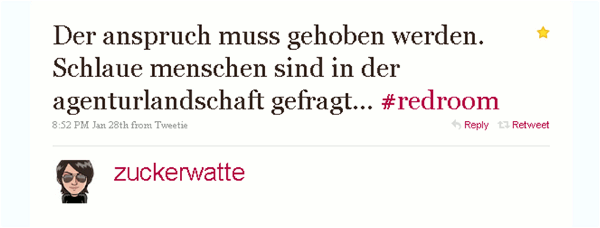
Die Frage jedenfalls, wie die Werbebranche wieder in eine Position kommt, in der die Kunden auf Augenhöhe mit den Agenturen sprechen und in der auch wieder mehr Geld zu verdienen wäre, wurde an dem Abend mit dem Hinweis auf den “Anspruch” den die Branche an sich selbst stellen müsste beantwortet.

Wie so oft ist es aber spannender sich anzusehen worüber nicht gesprochen wurde. Im Redroom war dies das Thema “Nachwuchs”. Zwar bemerkte Rudi Kobza dass die guten Jungen fehlen würden und auch Sebastian Loudon fragte Demner und Kassaei explizit welchen Nachwuchs man bräuchte - darauf eingegangen wurde allerdings nicht.

tweet_agenturen

Wo sind also die Jungen, die die Werbebranche wieder dort hinführen könnten wo sie sich in den 60ern wähnte? Die Frage die sich Herr Kobza stellt lässt sich eigentlich sehr einfach beantworten.

Wenn ich mich an den verschiedenen Fakultäten umsehe an denen ich studiere oder studiert habe, egal in welchem Land, dann stelle ich fest, dass die wirklich talentierten Leute die Innovatoren und Leuchttürme in ihrem jeweiligen Feld kennen. WIrklich motivierte Wirtschaftsstudenten kennen McKinsey, Booz, Apple, Microsoft oder junge Unternehmen die sich nie leisten könnten DDB zu engagieren, die IT-Nerds kennen die heißen Web-Start-Ups der jeweiligen Stadt, Google und co, die Designer kennen die “hot shops” die großartige Dinge für kleine Unternehmen machen oder Game Studios und viele schlaue - als Beispiel für Orchideenfächer - Anthropologen wissen viel über sehr vieles. Aber DDB interessiert sie alle aller Voraussicht nach nicht. Und im Gegensatz zu oben genannten bemüht sich die Branche auch herzlich wenig um sie.

Worauf will ich hinaus? Viele der smartesten Leute die ich in den letzten Jahren persönlich oder durch das Lesen ihrer Blogs kennen gelernt habe arbeiten bei Google, bei Microsoft, bei Nokia oder bei McKinsey. Andere, bis oben hin mit Fähigkeiten die für die Branche nützlich wären, arbeiten lieber auf ihrem Institut für die ESA, streben Firmen wie AdaptivePath an oder machen gleich etwas ganz anderes - von Gedenkdienst, über Lehrer bis zu Entwicklungshilfe. Die, die in der Branche sind oder sich für sie interessieren schauen zu Unternehmen wie Anomaly, Droga5, RGA oder AKQA, wechseln in die PR oder bauen Innovatives auf. Was sie alle gemeinsam haben ist, dass sie ihr Hirn dafür einzusetzen wollen um etwas verändern, nicht um “nur” Werbeideen zu generieren, in einer Branche die wenig bewegen kann und die - wie auch Tibor Barci erwähnt hat - noch dazu auf einer verstaubten Theorie aufgebaut ist.

Warum ist das so? Von den 60er Jahren bis in die 90er mag Werbung eine der treibenden kulturelle Kräfte gewesen sein. Definitionsmacht über Bedeutungen, conquest of cool, Rock&Roll und Mad Men. Heute hat die Spieleindustrie die Filmindustrie eingeholt, jeder kann immer kommunizieren (“Really simple stuff with objects looks like magic. Really hard stuff with screens still just looks like media.” - Russel Davies) und die Werbung ist nur noch ein kleiner, bei der Gesellschaft unbeliebter und für die meisten irrelevanter Teil der Creative Industries. Eine Branche die glaubt immer noch wahnsinnig interessant zu sein, der sich auf eine Werbeakademie als Nachwuchsschmiede verlässt wo viel mehr notwendig wäre und die - auch das sei gesagt - vergleichsweise miserabel entlohnt.

Klar, es ist immer noch ein unbeschreibliches Gefühl, wenn man mit seiner Arbeit ein Millionenpublikum beeinflussen kann. Aber muss man dazu heute in die Werbung gehen? Wie viel von dem was die Werbung macht ist denn wirklich gesellschaftlich relevant? Bei wie viel von dem was da an “Kommunikation” entsteht hat man das Gefühl an etwas großen beteiligt zu sein? Die Wahrheit ist: bei herzlich wenig. Darum, lieber Herr Kobza, interessieren sich die meisten meiner Kolleginnen und Kollegen nicht für “Werbung” an sich. Und darum fehlt Ihnen guter Nachwuchs in den Agenturen.


Update 1: Rudi Kobza war so freundlich mir auf Twitter zu antworten. Adaptiert zur besseren Lesbarkeit.

Kobza:

“mach dieselbe beobachtung. agenturen werden wieder interessanter werden. erlebs bei pr, strategy und digital. der einstieg in die agenturen wird aber auch von anderen bereichen als bisher kommen…”

Ich: Die Zukunft nicht im eierlegenden Wollmilchschwein, sondern in kleineren Spezialunternehmen? Wo sitzen dann die Strategen?

Kobza:

Sowohl als auch. Ich sehe 1. Spezialisten: machen Strategie und begleiten. Execution von Agentur oder Kundeninhouse, a la markenstern . Reines Consulting mit hoher Wertschaetzung. Gilt auch für Spezialisten rein digital, pr etc. Dann 2. Agenturen die im Kern Strategie, Big Idea Conception, Execution 360 und tägliche Idea Generation haben. Das die neuen Agenturen wo sich in meinen Augen noch eine große Konzentration abspielen wird. Und Kulturchange in den Agenturen. Dieser Agenturtypus hat sicher auch eine starke Agenturbrand, ist angesehen und wertgeschätzt weil top people. Auch durch laufendes proof of concept - große Kampagnen, Momentum, Innovation, Strategie, Performance etc. daily proofed. Ja und dann seh ich 3. die klassischen Kampagnenmacher die sich auf den Kern der Idee reduzieren. Da fallen mir jetzt schon manche Agenturen ein, die sich plötzlich im Wettbewerb mit freien Teams befinden. Meiner Ansicht zu eng. Die Kategorie der Executoren hab ich bewusst weggelassen weil die können vom Studio bis zum Kunden überall sitzen.

Fazit: 1. und 2. Find Ich persönlich interessant 1. Soll Markenstern, kobza integra abdecken. ad 2. wird sich Lowe GGK als eine der stärksten Agenturen hinentwickeln inkl digital.


Update 2: Die Antwort von Amir Kassaei

Das mit dem Nachwuchs stimmt. Ist aber wieder eine Bestätigung meiner These. Weil wir nichts mehr zu bieten haben, kommen auch nicht mehr die talentierten Leute.

Ich: Ich stimme der These ja zu. Aber für mich muss das auch mit einer Änderung im Recruiting einher gehen. Und das tut es nicht.

Ja, wobei ich sogar so weit gehe zu sagen dass think tank der modernen Prägung ohne Erbe aus der Kommunikationsbranche durchstarten müssen. Heißt auch ganz andere Jobprofile und Menschen. DDB ist und bleibt ein Kommunikationsdientleister das was ich meine hat aber nichts mit DDB zu tun. Auch nicht mit dem Berufsbild des Kommunikationsprofis.

Ich: Davon rede ich ja. Für “back to the roots”, ob als “Think Tank”, als “kreative Unternehmensberatung” oder in einem Modell wo man Joint Ventures eingeht braucht man andere Leute als die Kommunikationsbranche. Und Wandel aus dem Inneren ist unmöglich?

Ja, weil KFZ Mechaniker dich nicht verstehen wenn du zum Mond willst. ;-)

Virale Werbung: Ausblick am Ende der Bakkalaureatsarbiet (Sommer 2008 - Letzter Teil der Serie zu viraler Werbung)

Posted in bachelor thesis / Bakk-Arbeit, kommunikation, uni by thomas on the December 30th, 2009

Die vorliegende Arbeit sollte das Konzept Virale Werbung beleuchten und die Erwartungen an ihre Nutzung und Wirkung anhand theoretischer und praktischer Ressourcen herausarbeiten. Während im ersten Teil gelungen ist das Konzept entsprechend abzugrenzen, beziehungsweise zu erweitern und auch auf die zweite und dritte Forschungsfragen einige Antworten gegeben wurden, stehen am Ende dieser Arbeit wie erwartet mehr Fragen als Antworten. Dies liegt vielleicht daran, dass Antworten in Form von Erwartungen erst recht wieder Fragen an die Realität eröffnen.

Im Bereich der Reichweitengewinne durch Virale Werbung zeigt sich weitgehende Einigkeit zwischen den herangezogenen theoretischen Ansätzen und den Annahmen der Praxis. Auch im Bereich der Nutzung gibt es – abgesehen vom Widerspruch für die Klassik relativ simple EmpfängerInnen und für das Virale kritische, kreative, vernetzte RezipientInnen zu sehen – einige Überschneidungen.

Die Antworten auf die Fragen zur Wirkung können allerdings nicht sonderlich befriedigend sein. Zum einen, weil die Forschungsergebnisse der 2-Step-Flow-Kommunikation – der heutigen Netzwerkforschung – mit jenen der Agenda-Setting-Forschung – die sich heute sehr wohl auch mit der Frage danach wie man über etwas denkt beschäftigt – kombiniert werden müssten, um eine bessere Antwort auf die Kommunikationsprozesse bei viraler Werbung geben zu können. Die Forschungsdesigns der Agenda-Setting und Netzwerkforschung könnten der Praxis hier vor allem ermöglichen, das Problem der Werbewirkungsmessung bei viraler Werbung zu lösen.

Zum anderen stellt sich bezüglich der Werbewirkung auch das Problem, dass es sowohl in Agenturen als auch in der Wissenschaft unterschiedliche Ansätze darüber gibt, wie denn Werbung nun funktioniert. Die Ansätze unterscheiden sich vor allem hinsichtlich der Bedeutung der Aufmerksamkeit bei der Rezeption, den Hierarchien der Verarbeitung und vor allem der grundlegenden Bedeutung von Kognition und Emotion (Vakratsas/Ambler 1999, Heath/Feldwick 2008). Auf dieser Ebene der individuellen Rezeption braucht es deshalb andere Ansätze als die hier vorgestellten.

Die explizite wissenschaftliche und implizite praktische Theorie gibt jedenfalls viele Fragen nach der Rezeption, Nutzung und Wirkung viraler Werbung auf. Einige davon:

  • Wie wird Virale Werbung rezipiert?
  • Wie unterscheidet sich die Rezeption von viraler Werbung und TV-Werbung hinsichtlich der Zuwendung?
  • Welche Nutzen ziehen Menschen aus der Rezeption von Werbung?
  • Welchen Nutzen ziehen Menschen aus der Weiterleitung von Werbung?
  • Welche Auswirkung hat die persönliche Empfehlung einer Werbung auf die Werbewirkung?
  • Welche Auswirkung hat die Rezeption einer Werbung über Angebote wie YouTube auf die Wirkung, wenn die Werbung selbst gefunden wurde?
  • Bestehen Unterschiede in der Werbewirkung zwischen EmpfehlerInnen und EmpfängerInnen?

Wie immer folgen auf einige Antworten also viele weitere Fragen.

Vakratsas, Demetrios /Ambler, Tim (1999): How Advertising Works: What Do We Really Know? In: The Journal of Marketing, 63. Jg., Heft 1/1999, 26-43.
Heath, Robert/Feldwick, Paul (2008): Fifty years using the wrong model of advertising. In: International Journal of Market Research, 50. Jg., Heft 1/2008: 29-59.